How Does the US Do It?

Hello there, curious people.
In this article, we’re going to discuss the United States ‘gold standard’ for the analysis of information by the Intelligence Community: Information Communication Directive 203 (ICD203). We’ll cover how it can be used to figure out whether the information is reliable or not and look at a simplified breakdown of what each of its parts means.
An Example
ICD203 is what the US Intelligence Community uses as a basic foundation to start figuring out how likely something is to be true and how confidently they can predict something has happened or will happen.
Let’s try to use it to establish the accuracy of a made-up claim, based on what we can discover online.
Scenario: Multiple websites and social networks are reporting that famous actor Saylor Twift and his management team are in secret talks to plan a movie shoot in a country where vodka is the national drink, and where he will have dinner with the head of state (who happens to have a poor human rights record) to discuss a PR campaign later this year.
Analysis: Two criteria in this scenario need to be evaluated.
- Saylor and his management team are in secret talks to plan a movie shoot in a nation hostile to his own.
- There are plans to arrange a meeting with the head of state for said nations' benefit.
Let’s ask some questions.
Sources
- Q: Which sources do we have access to?
A: We have access to the following sources in order of confidence.
— Saylors’ barber is dating a member of the analysis team. High confidence, as they share everything and the barber has already provided verifiable information even though he’s under NDA with Saylors’ management team.
— International Civil Aviation Organisation (ICAO) and European Travel Commission (ETC) travel agency records. High confidence as inaccurate records carry significant legal and financial penalties.
— Screen Actors Guild — American Federation of Television and Radio Artists (SAG-AFTRA) insurance records. High confidence as inaccurate records carry significant legal and financial penalties.
— Independent media scoring between 75 and 85 on the World Press Freedom Index. Medium confidence, as the quality of each journalist’s contributions has been found to vary over time.
— Saylors agent: Medium confidence due to the facts that the agent has regularly provided good quality information to the public, she is secretly a known addict and, therefore open to exploitation.
— Saylors website: Low confidence as the website is not well maintained and has had to correct multiple posts based on venues, interviews, and events falling through.
— VT State media. Low confidence as they have been found to have repeatedly published false stories and pushed detrimental narratives.
— Bloggers in the nation of interest. Low confidence as they have been found to have repeatedly published false stories and pushed detrimental narratives.
Bias Check
- Q: Are we Twifties from a nation outside of the vodka-loving nation?
A: Yes, we probably are. This likely means that we don’t want this to be true. As such, we have to be aware of this and be willing to accept that it is true, if that’s where the evidence leads.
Judgements and Assumptions
- Q: Is Saylor popular in the nation of interest?
A: Yes, Saylors movies are dubbed into 35 languages. In fact, tour operators there have started arranging package holidays for citizens to travel to other countries to see his movies. -Judgement: Records of travel obtained from high-confidence sources. - Q: Has Saylor visited the nation before?
A: Saylors insurance records and press releases seem to indicate that he has never travelled to that country, but there is a travel record for a 1989 holiday to a coastal village in that region. During a private get-together, the member of the analysis team dating the barber engaged in a private conversation with Saylor where he disclosed that trip with his first love, who subsequently died from Leukemia was that happiest time of his life. — Judgement: Records of travel and experience obtained from high-confidence sources. - Q: Does Saylor have time or inclination to travel to this nation?
A: Evaluation of information collated from Saylors barber, agent, website, and press releases, the following conclusions can be reached: Saylors schedule is booked solid for the rest of the year with the previously mentioned travel to promote his last movie, as well as a planned shoot in Mexico scheduled to commence November. Also, his net worth has exceeded that of the head of state and he is known to be charity-minded, humanist, and altruistic. Assumption: Medium confidence due to mixed reliability of sources. - Q: Have his promoters announced any press events in the nation of interest?
A: No, the press junket dates announced on his website only include Austria, Canada, Poland, and the UK. — Assumption: May not be current or accurate as obtained from a low confidence source. - Q: Has Saylor expressed affinity with the nation or head of state in the past?
A: Saylor has never made any public statement on the nation or its head of state. However, his barber has disclosed that he has gone on several vitriolic rants about the head of state privately. — Assumption: Whilst this information did come from a high confidence source, it was hearsay disclosed during a drunken wrap party.
Alternatives
- Q: Could Saylor be planning to defect?
A: Highly improbable. Saylor has publicly and privately repeatedly demonstrated his love for the people, culture and politics of his home nation. - Q: Could Saylor just want to relive old memories and revisit the coastal village he visited in 1989?
A: Yes. As disclosed by Saylor himself, it was the happiest time of his life.
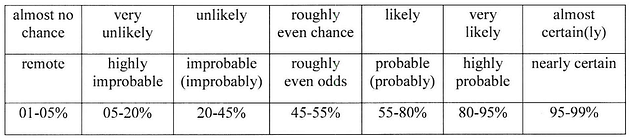
Answer: We appear to be able to demonstrate (based on what we currently know and what we currently assume) that it is very unlikely, and highly improbable (05% — 20%) that Saylor Twift will travel to said country. Further, it seems there is almost no chance and a remote probability (0% — 5%) that he will want to meet the head-of-state. Go Say-Say!
This is far from a perfect example, but it does convey the basic tenets of how ICD203 could be used. Information products do tend to be significantly more detailed and less twee though.
Five Analytic Pillars
ICD203 mandates the use of the following five pillars.
- Objective: Be fair and honest, above all. Think carefully about our ideas and why we think that way. We should look at things from different points of view and not just believe what we already think based on past experience. When new things happen, we should be ready to change our minds.
- Independent of political consideration: Don’t try to make things look good for one group or another. Just tell it like it is, without caring what way it makes anyone look.
- Timely: Tell others what verified information has been discovered as soon as possible. Pay attention to what’s happening in the world, what other people need to know, and when.
- Based on all available sources of intelligence information: Use all the information that can be found. Look for any missing pieces of information and try to find out more.
- Follow the nine Tradecraft Standards: In-line with lCD206 requirements.
Nine Tradecraft Standards
Tradecraft describes techniques, methods, and technologies the Intelligence Community use to find things out without being discovered.
- Checking Sources: Tell others where the information was found and how it was found. We should say if the source seems reliable, or not and whether their information is good or not so good, as a result. We should think about whether the information is true, complete, and up-to-date. Writing down a checklist of a source's strengths or weaknesses is a good idea. Multiple reliable sources are usually better, although one reliable source is better than a hundred unreliable sources.
- Confidence in Our Ideas: We need to honestly understand how sure we are about the information we process. This is hard because not being sure of things can feel uncomfortable. As a result, most people act intuitively and overestimate their knowledge. We should explain why we think something will happen, or will not happen no matter how it makes us feel. We need to be clear about what we don’t know and strive not to try making things up, to fill in gaps. We should figure out how to ask good questions using methods like the Five Whys to work out how probable or likely anything is in-line with the following table.
3. Knowing the Difference: We need to be able to tell the difference between what we know for sure, based on empirical evidence and what we think might be true based on our assumptions.
4. Thinking About Other Ideas: We should look for multiple other ways things could happen, aside from what seems obvious to us. We may find an alternative that makes more sense, even though we didn’t think about it at first.
5. Helping People Understand: We need to know our audience. When we understand the gaps in our knowledge and have achieved a reasonably high level of confidence in the information we have we should present that to others in a way that matters to them and that they can use.
6. Being Clear: We should make our explanations easy to understand. We should explain our ideas in a way that makes sense to others and avoid jargon or technical language as much as possible.
7. Saying What’s Changed: We should never be afraid of changing our minds. If we find better, or more reliable information, we have a duty to let others know how our ideas have changed. This is simply continuous improvement.
8. Being Accurate: Excellence, integrity, and rigor are all things we should prize and strive for. We shouldn’t avoid hard decisions because we’re worried about being criticized. There aren’t many more noble achievements than continuing to improve your knowledge and sharing verifiably accurate information with others who can use it, even when that information isn’t always positive.
“Use a picture. It’s worth a thousand words.” — Arthur Brisbane
9. Using Graphics: Pictures, graphics, presentations, interactive displays and other visual content can easily convey more information to help others understand things easier than any thousand page book. Pictures can make it easier to see how things are connected. These types of information should pass the same scrutiny as anything else in the previous steps though, or we run the risk of exploitation like Deceptive Imagery Persuasion (DIP — Will be explained in a future post).
In this post, we covered an impractical example of using ICD203. We also explored what the underlying parts of the process are. In future articles involving analysis of mis/dis/malinformation campaigns, we will try to include GUEST defence, ICD203, and/or Bayesian Inference breakdowns at the bottom, where applicable (Don’t worry about what these mean yet, they are explained in other posts that will be linked soon).
Remember; It’s a jungle out there!